Quick answer
Risk-based model portfolios are ready-made investment mixes offered inside a retirement plan, each built for a different level of risk, such as conservative, moderate, or growth. A participant picks the portfolio that matches their comfort with market swings, and a professional manages the underlying funds and rebalances the mix over time. They simplify choices, but they do not remove investment risk.
The problem model portfolios try to solve
A typical 401(k) or 403(b) menu might include a dozen or more funds. Many employees are not sure how to combine them, so they spread money evenly, pick whatever did well last year, or leave everything in cash. Those habits can leave savers taking more risk than they realize, or less than their goals require.
Risk-based model portfolios offer a middle path. Instead of building their own mix, participants choose a professionally designed portfolio that fits their risk profile. The plan still offers individual funds for people who want to make their own choices.
How risk-based model portfolios are built
Starting with a range of risk levels
A plan usually offers several portfolios along a spectrum. A conservative portfolio might hold more bonds and stable value or cash-like investments. A growth portfolio typically holds more stocks. Portfolios in between blend the two. The exact mix of each one is set by the manager’s asset allocation policy.
Using the plan’s own funds
In many plans, the model portfolios are assembled from funds already on the investment menu. That keeps the structure transparent: participants can see which funds they own and in what proportion. It also means the quality of the models depends on the quality of the underlying lineup, which is why ongoing investment lineup reviews matter.
Rebalancing over time
Markets move, so a portfolio’s mix drifts. If stocks rise sharply, a moderate portfolio can end up holding more stock than intended. Rebalancing brings it back to target on a set schedule or when drift passes a threshold. The manager may also update the target mix itself after reviewing market conditions or the plan’s needs.
How model portfolios compare with other options
| Option | How the mix is set | Main trade-off |
|---|---|---|
| Risk-based model portfolios | Participant picks a risk level; the manager maintains the mix. | The participant must revisit their choice as their situation changes. |
| Target date funds | Based on an expected retirement year; the mix becomes more conservative over time. | Ignores personal risk tolerance beyond the retirement date. |
| Self-directed fund selection | Participant chooses and rebalances individual funds. | Requires time and knowledge many participants do not have. |
None of these is right for everyone. Many plans offer more than one approach so participants can choose the level of involvement that suits them.
Why plan sponsors consider them
- Simpler decisions for employees. Choosing one portfolio by risk level is easier than assembling five funds.
- Professional oversight. Allocation decisions and rebalancing are handled by an investment professional under a written policy.
- Consistency with the plan’s process. The portfolios can be governed by the same investment policy statement that covers the rest of the menu.
- Possible use as a default. Depending on how they are structured, some model portfolio arrangements may be considered as a plan’s default investment. Whether a specific option qualifies under Department of Labor rules is a question for the plan’s advisers and counsel.
Risks and limitations to weigh
Model portfolios are a tool, not a guarantee. Sponsors and participants should understand that:
- All portfolios can lose value, including conservative ones.
- A risk label is a general description. Two managers’ “moderate” portfolios can look quite different.
- Participants may pick a portfolio once and never revisit it, even as their age, savings, or goals change.
- Management may add a layer of cost, which should be disclosed and evaluated for reasonableness.
- Results depend on the underlying funds and on the manager’s allocation decisions.
Clear participant education helps. Many plans provide a short questionnaire so employees can match themselves to a risk level, along with plain explanations of what each portfolio holds.
The fiduciary side of offering model portfolios
Adding model portfolios to a plan is a fiduciary decision. The sponsor needs to choose the portfolio manager prudently, understand the fees, and monitor the portfolios over time, just like any other plan investment. The general framework is covered in what it means to work with an ERISA fiduciary.
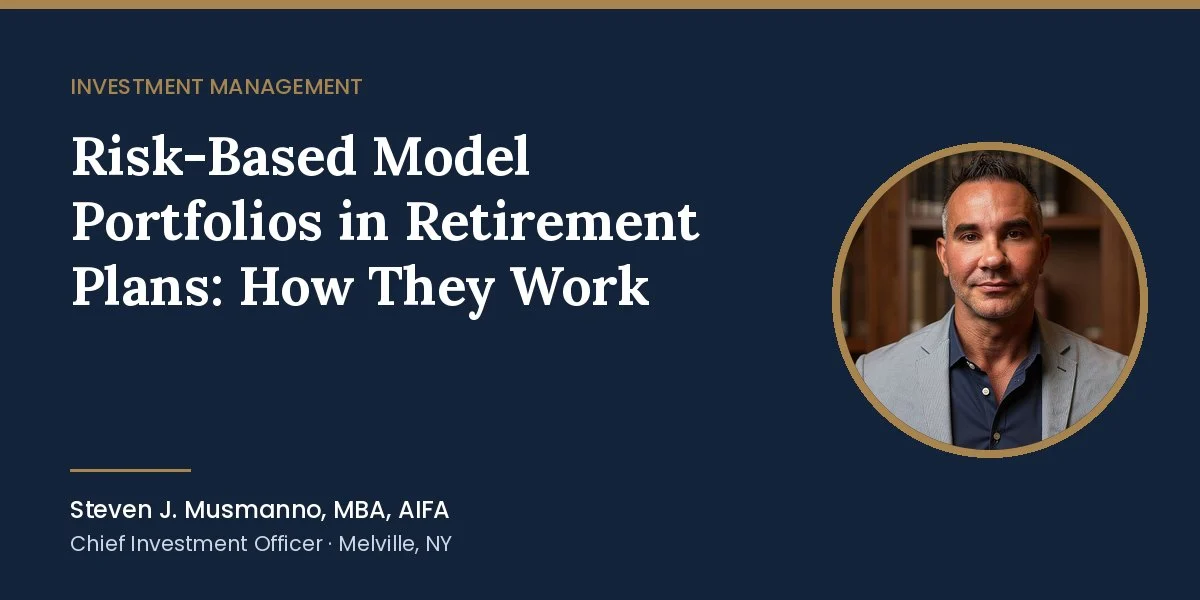
At APS Investment Management, the institutional fiduciary arm of APS Pension & Financial Services in Melville, New York, Steven J. Musmanno serves as Chief Investment Officer. He sets asset allocation policy and direction for APSIM’s risk-based investment portfolios and leads their portfolio management. More about that work is on the investment management page.
Questions a sponsor can ask a portfolio manager
- How many risk levels are offered, and how is each one defined?
- Which funds make up each portfolio, and who chooses them?
- How and how often are the portfolios rebalanced?
- What does the manager charge, and how is that disclosed to participants?
- What reports will the plan committee receive, and how often?
- What participant education materials are included?
Key takeaways
- Risk-based model portfolios let participants choose a professionally managed mix by risk level.
- They are often built from the plan’s existing funds and rebalanced on a set schedule.
- They simplify decisions but do not remove the risk of loss.
- Participants should revisit their portfolio choice as their circumstances change.
- Selecting and monitoring the portfolio manager is a fiduciary responsibility for the sponsor.
Frequently asked questions
Are risk-based model portfolios the same as target date funds?
No. Target date funds adjust automatically based on an expected retirement year. Risk-based portfolios stay at the chosen risk level until the participant decides to switch.
Can a participant use a model portfolio and individual funds at the same time?
That depends on the plan’s rules and recordkeeping system. Some plans allow it, while others require participants to choose one approach for a given balance.
How does a participant know which risk level fits?
Plans often provide a risk questionnaire and educational materials. Participants may also want to consider their time horizon, other savings, and how they would react to a market decline.
Who is responsible for monitoring the model portfolios?
The portfolio manager manages them day to day, but the plan sponsor or committee remains responsible for monitoring the manager and the portfolios as plan investments.